Monday, June 22, 2015

A Peek Into My Camera Bag

Camera Accessories, 2015
As I’ve been reading through various photography blogs lately, there have been numerous articles about what you’ll find inside photographers’ camera bags and kits. Most talk about fancy, high-end lenses, flash units, and specialty ND filters. But wouldn’t it be fun to see some of the everyday things we haul around? Here’s a look into my camera bag.

Along with my camera body and lenses, I have a number of small but useful items, including business cards and spare shutter release trigger (remote or cable depending upon where I'm going). Regardless of the type of bag I’m carrying – from backpack to handbag – these are the items I always have on hand along with a bottle of water, breakfast bars or trail mix, and heavy-duty bug repellant.

One of the most important items I carry is a fully charged spare battery; not to mention I try to not leave home without the in-camera battery charged up as well. There’s nothing worse than getting out into the field and having an expended battery.

The other essential are spare memory cards. There are usually 3 or 4 blank cards in various sizes from 4GB to 16GB. I like the Lowe Pro Accessory Wallet for storing the cards. It’s small and tucks into a corner of whatever bag I’m carrying while helping protect the memory cards from the elements.

Lens cleaning kits and cloths come in quite handy when I’m in the field. Shooting outside has some unique challenges, including pop-up rain showers and blowing dust. A quick swirl with one of my myriad wipes, and I’m back in business.

While I rarely shoot landscapes, I find it useful to have a three bubble spirit level on hand. It slips into the hot shoe on my camera, and provides a little extra help for keeping images straight. I have a tendency to list a little to the right, so it’s a good reminder. Never want to be a half bubble off plumb.

I almost always carry a Hoya Circular Polarizer in my bag. Regardless of the lighting conditions, it offers options to deal with the glare of the sun or add depth to a flat sky. I found it particularly useful recently when shooting at an old car show with highly polished hoods and ornamentation.

A couple of quarters always come in handy. Did you know they serve as great screwdrivers when the tripod body plate is loose? Learned that little trick in the field at a nature photography workshop awhile back.

Notebook, pen and a pocket calendar are almost always zipped into a side pocket. I like to note the shooting conditions and locations, such as weather and lighting. Some of the areas where I like to shoot don’t have Wi-Fi or 4G coverage (we’re talking remote), thus it’s an old-school approach to notes.

Two black plastic garbage bags enclosed in a clear plastic freezer bag store quite nicely, and provide a number of options for kneeling or laying on wet ground. They also provide a little extra coverage for the pop-up rainstorms mentioned earlier. If desperate, I can also use them as light blockers and black backgrounds when shooting – not perfect, but a viable option.

I would love to have a quick peek into your camera bag. What unique items do you take along with you, and what can you not do without?

Saturday, June 20, 2015

6th Annual Nature & Wildlife Exhibit

Just a quick announcement

I had the honor of being one of the artists selected to exhibit at the 6th Annual Nature & Wildlife Exhibit. The show begins July 25, 2015 with the opening reception, and runs through August 31, 2015. I will be exhibiting a photograph entitled "Azalea for Edward." The exhibit is held at the St. Augustine Art Association, 22 Marine Street, St. Augustine, FL. Hope to see you there.

Tuesday, June 9, 2015

Quick Tips for Photographing Butterflies & Dragonflies


Lately there have been a number of butterfly and dragonfly photos on the various photography pages I follow. And these insects are certainly abundant in the spring and summer. After spending a couple of days recently chasing “dragons,” I thought you might like a few useful tips based on my own experiences.

1. Practice patience! This is the first key to successfully photographing flying, flitting insects. They eventually land on branches or rails, and wait for you to catch them. But it takes time and persistence.
monarch butterfly resting on red and yellow butterfly milkweed plant
Monarch Butterfly on Milkweed

2. Use camera settings to isolate your subject, bringing it into focus, and to blur the background. For the images here I used an aperture of f/5.6, which creates a shallow depth of field and the soft background.

3. In order to keep disturbance to a minimum and remain outside of the “circle of fear,” I have been shooting with a telephoto lens zoomed to around 150-200mm. This keeps me at a distance, but brings in the details of wings and bodies.

4.  These are fast little creatures. In order to avoid blur from their constant motion, use a fast shutter speed. I’ve been using manual mode for the insect photography, setting my shutter speed to about 1/320 seconds for correct exposure and stopping the motion.

blue pond skimmer dragonfly
Blue Dragons
5. Auto-focus can be challenging when shooting butterflies and dragonflies. Depending upon where you’re positioned, there may be insufficient contrast between the background and the subject, making auto-focus less effective. I get some of my best shots using manual focus.

I’d love to hear your tips on photographing butterflies and dragonflies.

Friday, May 8, 2015

Night Magic

Chinese dragon lantern at night
Chinese Dragon, copyright 2015, Stephanie Maatta Smith
A week or so ago I went on my first intentional nighttime photo shoot. Our local zoo has a gorgeous exhibit called Zoominations, A Chinese Lantern Festival. The lanterns are beautiful in the daylight, but stunning after dark. The display will be at the zoo through the end of May. Perhaps we'll get back there again before it leaves.

Due to the number of guests in the zoo and the set up of the lanterns and lighted displays, it wasn't possible to use a tripod. In order to have a fast shutter speed for handheld shooting, I had to crank up the ISO; luckily there was sufficient ambient light to help compensate. I also used a 50mm with a wide f-stop for many of my images. Most of the images were made at f/5.6 and 1600 to 2000 ISO. Some of the images are a bit grainy, but it was a willing sacrifice to capture the vivid colors against the darkening sky.

archway of Chinese lanterns
Apsaras, copyright 2015, Stephanie Maatta Smith
The Apsaras was an ancient fairy in Taoism and Buddhism thought to bring peace and happiness to the world. These formed an arch along the walkway with glittering stars shining above.

A section of the river was decorated with koi and lotus flowers with some of the flowers holding giant pearls. Koi appeared to leap from the river, with water shimmering around them. This was one of my favorite areas of the exhibit.

Peacock, Chinese lanterns
Peacocks Aglow, copyright 2015, Stephanie Maatta Smith
Brilliant peacocks also lit up the night with flashing colors and movement. They were placed in one of the darker corners of the zoo to enhance the magic of the colors. Trees surrounding the area had LED icicles twinkling, almost as if they were raining stars.

Chinese lanterns in shapes of koi and lotus flowers
Koi Pond, copyright 2015, Stephanie Maatta Smith

Lessons learned were patience to set up the image, balance shutter speed and ISO to catch both good exposure in low light and movement of the displays, and isolate the subject carefully because so much color, shape and lines were happening among the lanterns.

Friday, March 20, 2015

B&W February

black and white image of azaleas in bloom
Azaleas in Bloom, copyright 2015, Stephanie Maatta Smith
My online photography group participated in a photography book club during the month of February. We read Andrew S. Gibson's The Magic of Black & White Part 1 - Vision, and practiced making black and white photographs exclusively for the month, using his techniques and recommendations. The goal was to learn to "see" in monochrome, and to evaluate the effectiveness of color versus monochrome for impact. The take-away for me was learning how light changed an image when seeing it in color and then translating it to monochrome. This exercise also provided more opportunities to discover my camera's features and settings I normally don't use.

Black & White Collage, copyright 2015, Stephanie Maatta Smith

Stripping away color brought out the subtle details which might otherwise be missed, such as the glowing center of the tulips and the delicate lacing of the spider web. I also found, for me, simple composition is more effective than complex images.

Tuesday, January 27, 2015

Holy Hannah!


image of nikon camera with sigma 150-500mm lens attached
Holy Hannah! copyright 2015, Stephanie Maatta
Time for an update ... Recently I rented a wildlife/nature lens for a trial run -- a Sigma 150-500mm f5-6.3. The camera shop told me it was an excellent choice for birding. And, indeed it was. I had it for 10 days, and tried it out in a variety of environments: nature preserve, county park, local zoo, and around home.

anhinga, great blue heron, snowy egret
Bird Collage, copyright 2015, Stephanie Maatta

Thoughts & IMOP...

This is a beautiful lens. It offers excellent clarity and minimal chromatic aberrations. The optical stabilization is superior, allowing for hand-held functioning despite weight and length of the lens. It features both auto-focus and manual focus with a rear focus ring. The rear focus is a great help for maintaining control over the lens.

Savannah sparrow on branch
Savannah Sparrow, copyright 2015, Stephanie Maatta
alligator on lake bank
Mister Big, copyright 2015, Stephanie Maatta


On the plus side, my images came out clear with excellent color. I made very few adjustments to the images in post-processing.  I was able to shoot some excellent close-ups of wildlife without getting too close or disturbing the animals. It handled nature's smallest creatures as well as the larger variety.

For me the lens was heavy but manageable for hand-held shots. I used both hand-held and tripod with equal  effectiveness. At f5-6.3 it's a bit slower than the Nikon 80-400mm f4.5-5.6, but that wasn't an issue for me. Because of the length of the lens I needed room to maneuver comfortably. Not a good lens for a crowd.

Saturday, October 18, 2014

Worldwide Photowalk 2014

On Saturday, October 11th, photographers participated in a worldwide photowalk, sponsored by KelbyOne. There were 1052 walks around the world with 20,177 participants. This was the 7th annual photowalk. I had the opportunity to join an historical walking tour one in my family's hometown in Calumet, MI, as part of WWPD. While my photowalk group was small (just me and one other photographer), it was fun to see a familiar place through the eyes of someone else. The morning walk had beautiful light with enough clouds to make the sky interesting. I'll definitely do this again next year.

These are a few of my favorite images from the morning's event.

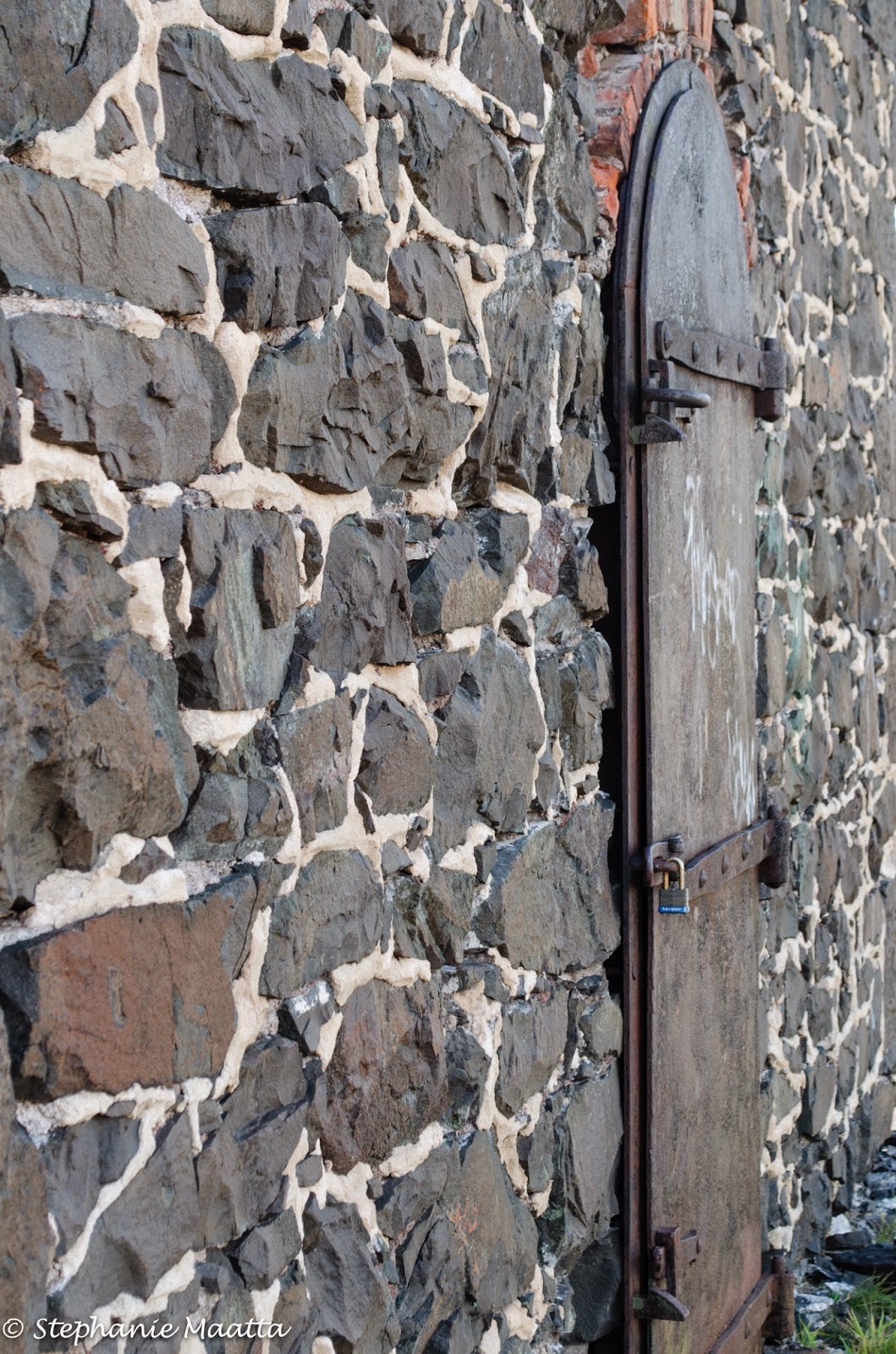
wooden door on a stone wall
Behind Door Number... copyright 2014, Stephanie Maatta Smith


stone building with a church steeple reflecting through a window
Steeple in the Distance, copyright 2014, Stephanie Maatta Smith

stone mine buildings covered in vines
Neglected, copyright 2014, Stephanie Maatta Smith

stone church with steeple
Steeples and Spires, copyright 2014, Stephanie Maatta Smith

building with caved in roof and church steepl in background, image in black and white
Steeple in Silhouette, copyright 2014, Stephanie Maatta Smith